
With Gaza in ruins and dispossession ongoing in the occupied West Bank, exile, identity and belonging have taken on renewed urgency for Palestinians. Jerusalem-born Steve Sabella, a "visual archaeologist" in his own words, has spent decades excavating and peace-ing together a reality fractured by exile and occupation. We visited the acclaimed Palestinian artist in his Berlin studio.
| Text and photos by Sarah Van Looy
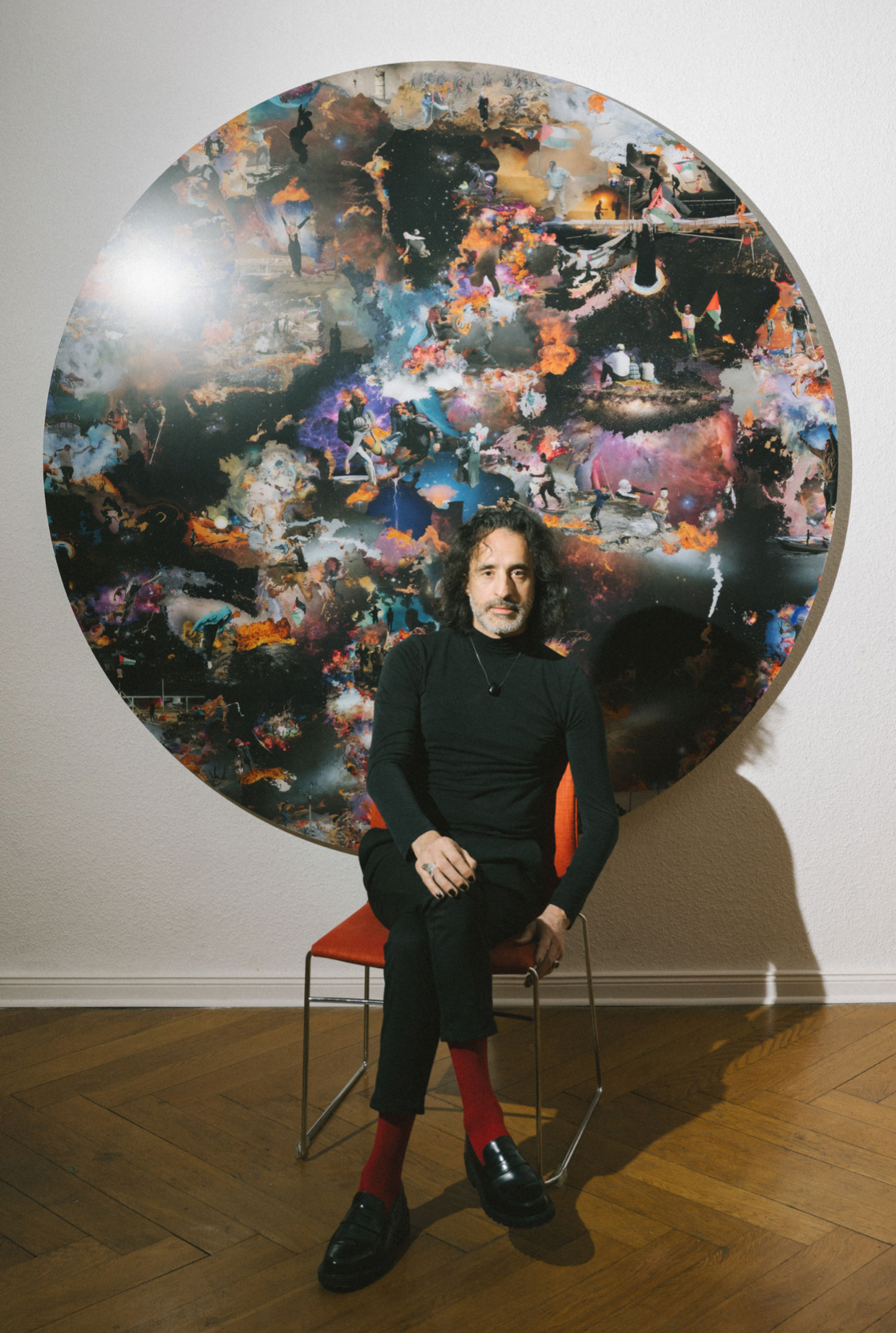
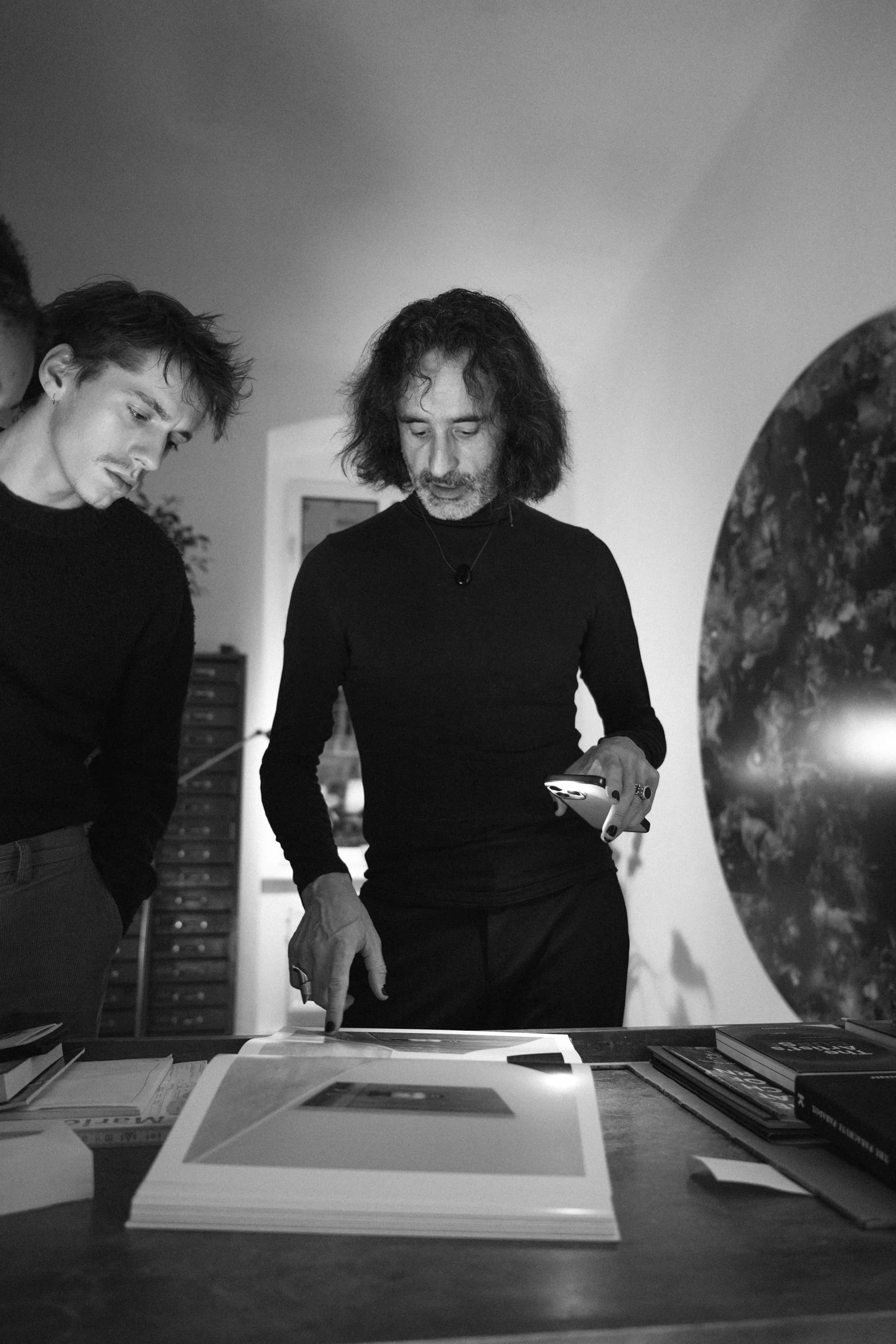
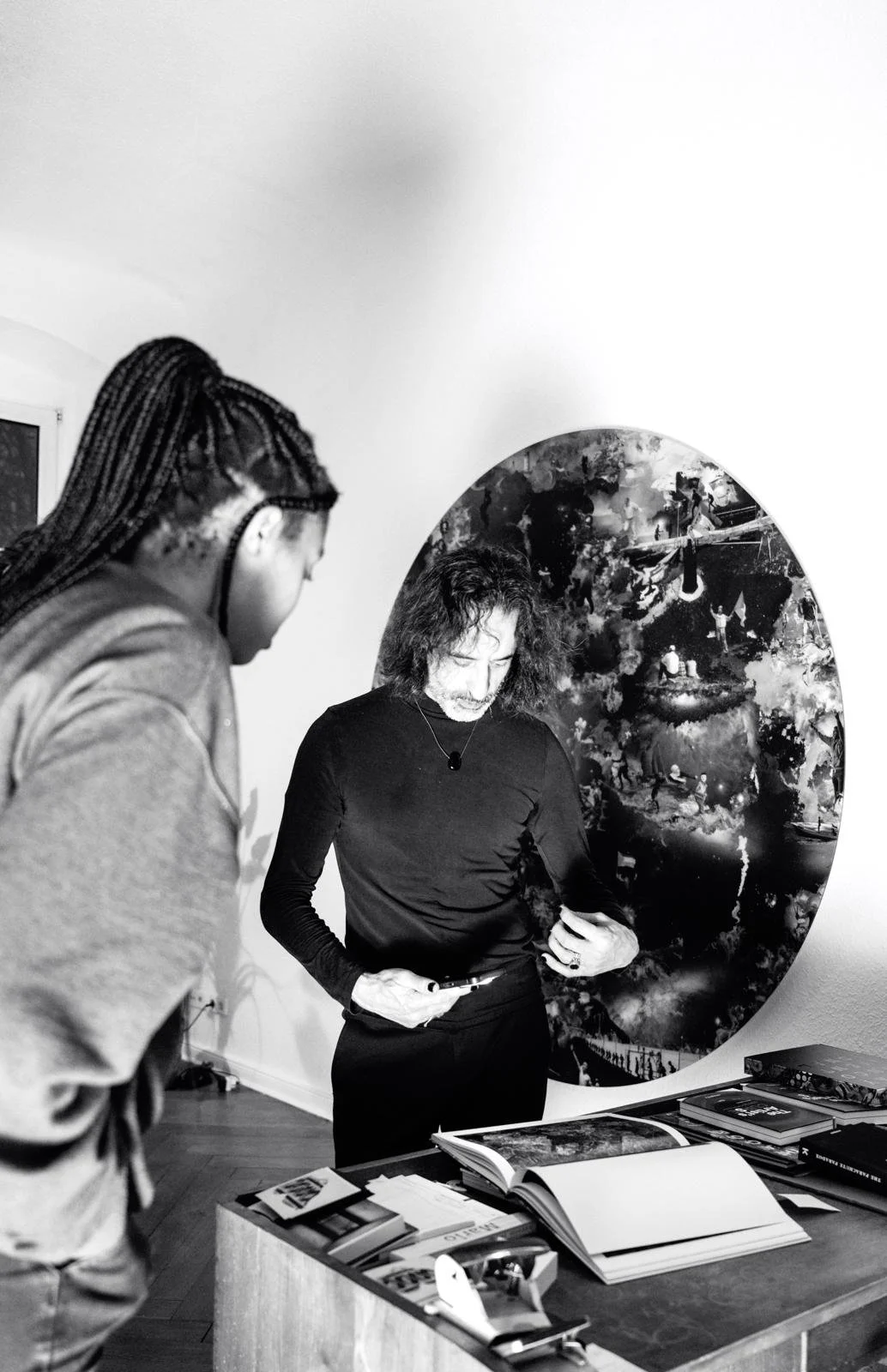
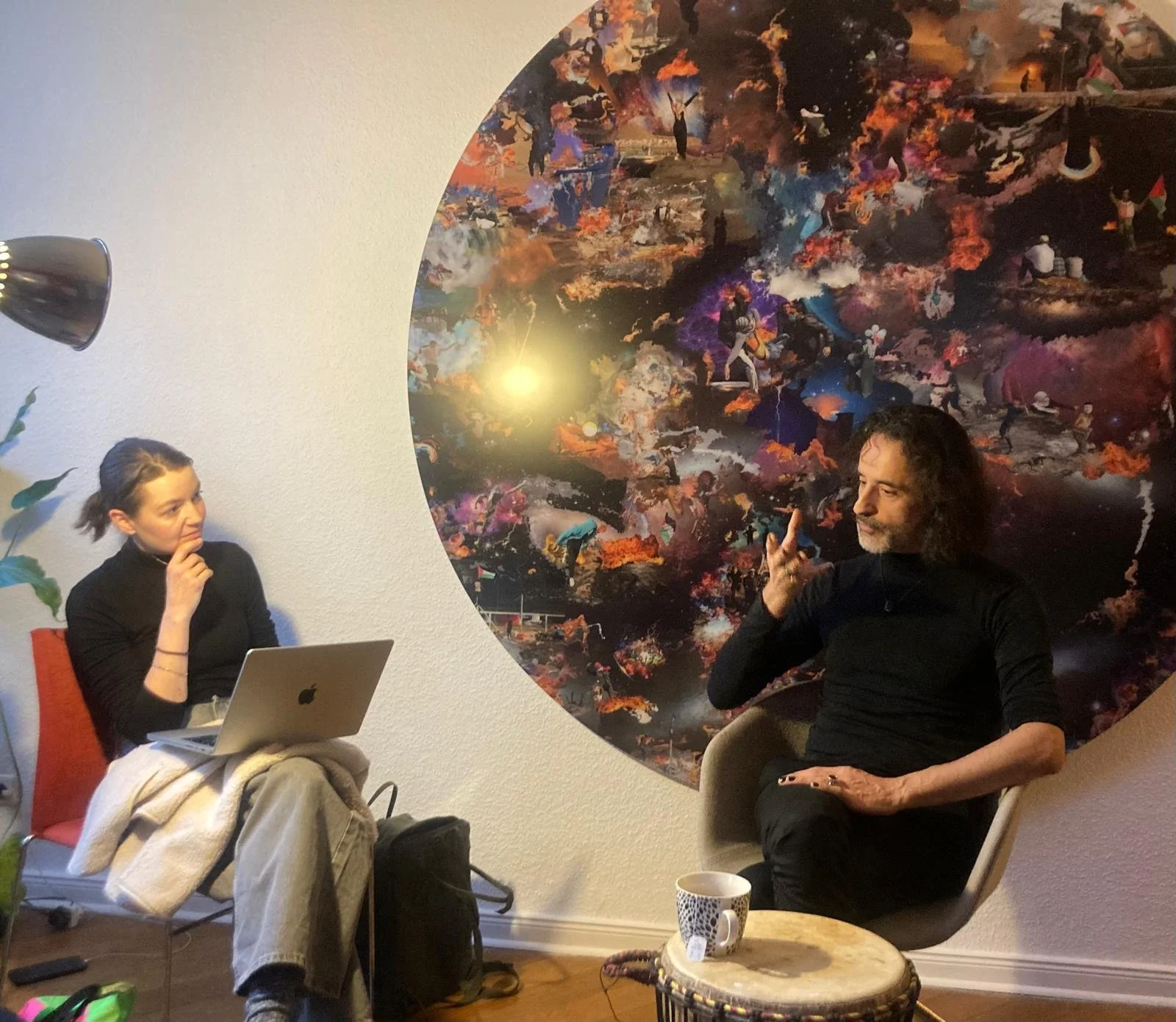
Fire. Smoke. Death. People protesting, screaming, bleeding. Tear gas rises and dissolves into floating clouds, merging with distant galaxies and shining stars into a great circular composition. From afar, “The Great March of Return” could be a Renaissance painting. Up close, the two-metre wide canvas reveals itself as a kaleidoscopic mosaic of photographs. "There are more than a thousand of them," Sabella says. "They document the crowds that gathered every Friday to demand an end to the occupation."
The work is from 2019, Sabella's tribute to the Palestinian fight for liberation. It is a visceral piece by an artist whose own battles for identity, for justice, and for a place in the world have long echoed those of his people. "This kid was killed," he comments, pointing to a fragment within the vast composition. Seven years and one genocidal war later, the tragedy captured in this contemporary fresco resonates more than ever. It feels more tragic than ever.
Painting with light
The internationally acclaimed artist devotes countless days to meticulously crafting his compositions. The Great March of Return took over 700 hours to complete. He usually works from his own images, but in this case he turned to the photographs of five Palestinian photojournalists, cutting and piecing them together late into the night. "I was searching for the space where they would merge," he explains. "Then I thought the work had to be circular. I wanted to hold the idea of infinity against the entrapment of Gaza."
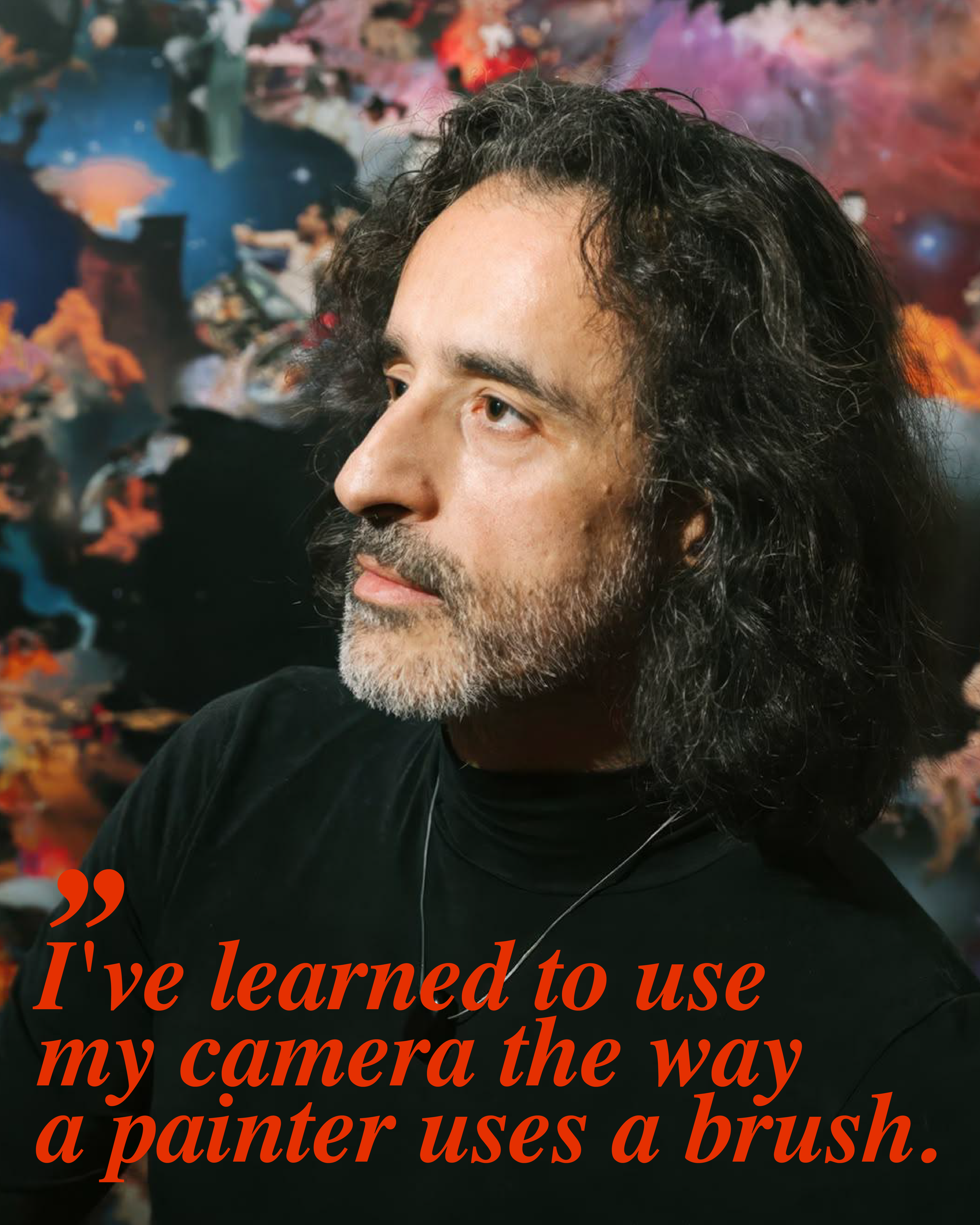
Sabella likes to say he uses images as his brush, fusing fragments into a new kind of seeing. "People often think I'm a painter," he says. "Over the years, I've learned to use my camera the way a painter uses a brush."
Sabella picked up his first camera as a young boy in Jerusalem. "I was impatient. I needed a fast medium, a quick way to express myself, to cope with my surroundings." Reaching for his father's Konica helped him make sense of a world that felt wrong, his experience of being a second-class citizen in his own land, and that longing for a lost home that would inform his work and life across the years and places.
"The Palestinian reality is one of fragmentation, dislocation and the absence of a centre point. Today, I feel far less fragmented.”
Peacing the Fragments Together
"I often say my life is mirrored in my art, and my art is about my life." One need only look at the works lined up on the wall of Sabella's Berlin apartment to see that they read like phases of an artist's journey. For this born exile, each artwork is another attempt at reinvention, one healing step at a time.
"I used to feel tortured," he admits. "It would take me months, even years, to wake up from a project. I truly believed that exile was forever. That this state of being locked within oneself was eternal. But I found liberation."
A turning point came with “Independence” in 2014. "Look closely," he says. "You can see the bones are broken. It's a symbol of change, of being remade. Those are iPhone shots, taken at night in the sea in Croatia. I was photographing Francesca, my partner, and my daughter Cécile. I could see right through them, like X-ray vision." For Steve Sabella, it felt like a baptism. "At that moment, I felt liberated from the Israeli occupation. It drifted out of my veins completely, and I felt as though I was being born again."
For Steve Sabella, it is in the darkness of the sea and the darkroom that the eyes begin to see. "I live in the darkroom 24/7. For me, darkness is light. That's why jumping into the unknown never scares me. That's where the real work lives. The real thought. The real expression. The darkroom is my head.”
The Art of Deleting
Sabella calls himself a "visual archaeologist”, digging through photography's hidden layers, unearthing what lies beneath, creating new contexts. But the excavation does not stop there. He is also an archaeologist of the self, peeling back the layers of his own identity to craft his story, building from the fragments. In life, as in photography, it comes down to choosing what to keep in the frame – and what to leave out.
"Every photograph is an act of deletion. When you make a photo, what you’re really doing is deleting from the frame. What you choose to leave out is just as important as what you include. You need to leave room for imagination, for the viewer to create their own story, perception, and understanding of what you’re trying to convey. I love the art of deletion—it’s a central part of my creative process.”
Forty years down the road, Sabella hasn't relinquished the conviction that expression is reinvention, and he has his art to thank for it.
And yet, with maturity came another realisation: “I realised that I also needed to step back from the art reality. Art is a part of me. It can’t be all of me,” says Sabella. His frequent mention of long-term partner Francesca and their daughter Cécile makes clear there is more than art in Steve’s life. A happy family keeps him grounded. He also swears by his regular weekend clubbing routine, “for mental health purposes”, he insists.
Steve Sabella
Born in Jerusalem in 1975, Sabella is a Palestinian visual artist and author based in Berlin since 2010. His work explores exile, identity, memory and liberation through photography and photographic installations. He is the author of the award-winning memoir The Parachute Paradox (2016) and The Artist’s Curse (2023). His exhibition “The Liberated Image” is on view at the Einstein Forum in Potsdam through March 13, 2027.
Picture: Sarah Van Looy with Steve Sabella
